User permissions
Users can have multiple permissions. You see them on the user’s profile.
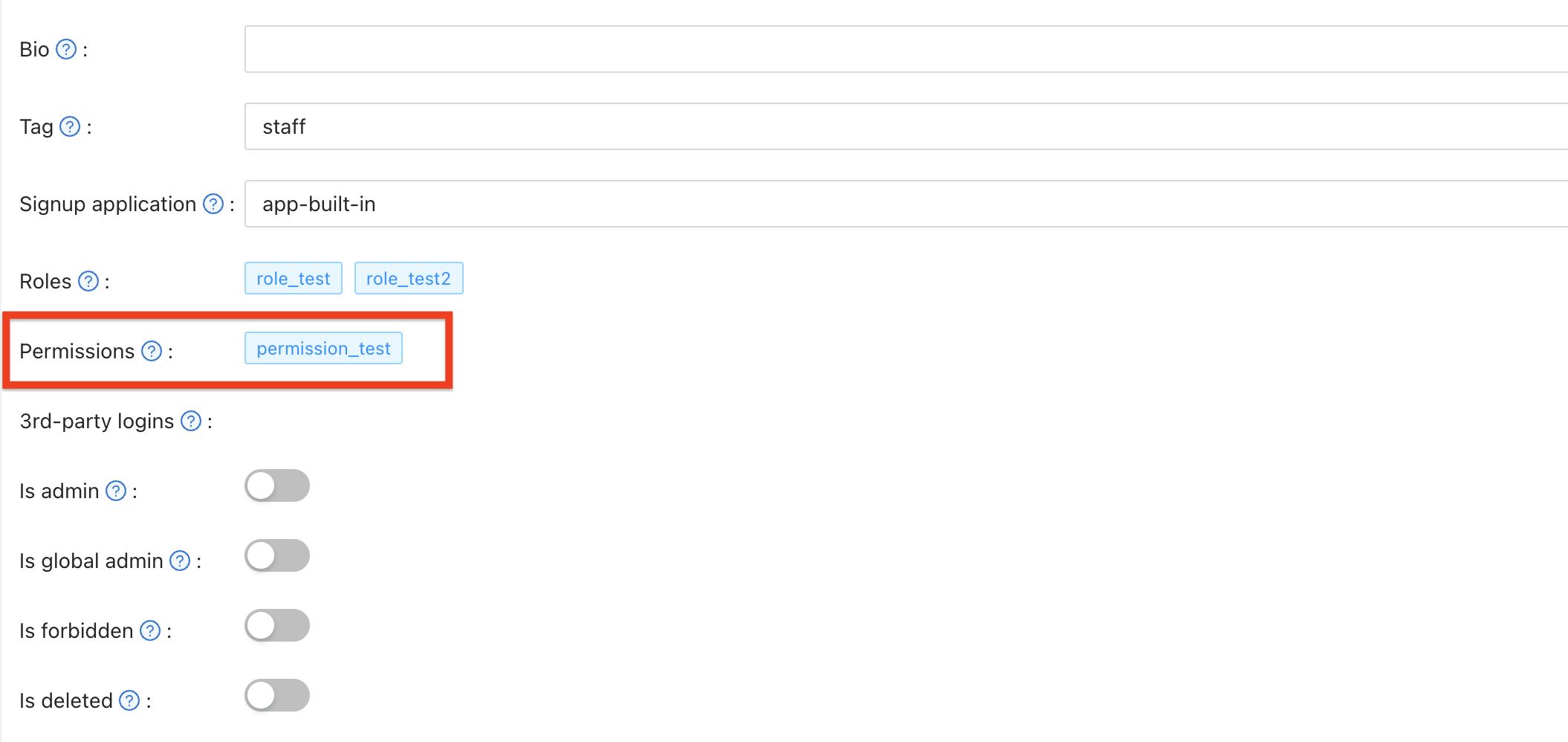
Permission properties
Each permission has: Owner, Name, CreatedTime, DisplayName, IsEnabled, Model, Users, Groups, Roles, ResourceType, Resources, Actions, Effect, ExpireTime. Users, Groups, and Roles list who gets this permission. See Configure a permission for the fields.
Managing permissions
Permissions are separate resources. The user’s Permissions field is filled when you load the user. To assign or change permissions, use the Permissions API, not the User API.
- Web UI: Permissions page (e.g.
https://door.casdoor.com/permissions). - API: Casdoor API reference — permission endpoints.
Update some fields of a permission
POST /api/update-permission?id=<owner>/<name> replaces the whole permission with the request body. Add the optional columns parameter, a comma-separated list of field names, to write only those fields from the body. The other fields keep their stored values. Field names can be camelCase or snake_case, for example columns=users,roles.
curl -X POST 'http://localhost:8000/api/update-permission?id=built-in/permission-read&columns=users' \
  --user '<client-id>:<client-secret>' \
  -H 'Content-Type: application/json' \
  -d '{"users": ["built-in/alice", "built-in/bob"]}'
If the permission doesn't exist, the response is "data": "Unaffected".
Update many permissions at once
POST /api/update-permissions takes a JSON array of complete permission objects. Casdoor identifies each permission by its owner and name, and checks each one in the same way as POST /api/update-permission, including the check against its model. Permissions that don't exist are skipped.
Casdoor rebuilds the Casbin policies of all changed permissions in one pass, instead of once per permission, so use this endpoint for bulk edits. The response is "data": "Affected" when at least one permission changed.
curl -X POST 'http://localhost:8000/api/update-permissions' \
  --user '<client-id>:<client-secret>' \
  -H 'Content-Type: application/json' \
  -d @permissions.json
Here, permissions.json contains the array of permissions, for example as returned by GET /api/get-permissions?owner=built-in and then edited.
Where the permissions of a user come from
A user has a permission in any of these cases:
- The user is in the permission's Sub users. This is a direct assignment.
- The user is a member of a group in the permission's Sub groups. If the user is in at least one group, a permission whose Sub groups contains
*or<organization>/*applies too. - The user has a role in the permission's Sub roles, including roles that the user has through groups or role hierarchy. See User roles.
When you fetch a user, each entry of permissions can carry sourceGroups and sourceRoles, the groups and roles through which the user has the permission. Empty or missing values mean a direct assignment. If the user also has the permission directly, both are empty. Casdoor computes them when the user is fetched and doesn't store them.
In the Permissions field of the user edit page, a directly assigned permission is a plain badge. An inherited permission is an outlined badge with an icon: a shield when a role grants it, otherwise a group icon. Hold the pointer over it to see the sources, for example Roles: built-in/role_admin.