概述
Casdoor基于OAuth构建,并使用令牌进行用户身份验证和授权。
访问令牌和ID令牌
登录返回两个不同的 JSON Web Tokens (JWTs):
- 访问令牌用于调用 API。其
tokenType声明值为access-token。 - ID 令牌告知您的应用程序谁进行了登录。其
tokenType声明值为id-token。
两种令牌都包含相同的用户声明,采用相同的 Token format(令牌格式),并使用相同的密钥进行签名。它们在以下声明上有所不同:
| Claim | Access token | ID token |
|---|---|---|
tokenType | access-token | id-token |
jti | Its own ID | Its own ID |
aud | The client ID, or the resource of RFC 8707, or the audience of a token exchange | Always the client ID |
at_hash, c_hash | Not present | Present in the cases that OpenID Connect defines |
对于共享应用,两种令牌的 aud 均为 <client-id>-org-<organization>,即该组织下应用的客户端 ID。由于这两种令牌是独立的,因此不能互相替代使用,这符合 RFC 8725 第 3.12 节的要求。请将访问令牌发送给 API,仅使用 ID 令牌来读取用户的身份信息。
/api/login 端点在其响应的 data3 字段中返回 ID 令牌。
令牌字段
Casdoor 将每个发出的令牌存储为一条记录,包含以下字段:
| 字段 | 描述 |
|---|---|
owner, name | The ID of the token record |
createdTime | When Casdoor issued the token |
application | The application that the token was issued to |
organization, user | The user of the token |
code | The authorization code that the token was issued for |
accessToken, refreshToken, idToken | 三种令牌。Casdoor 还会存储每个令牌的哈希值,分别位于 accessTokenHash、refreshTokenHash 和 idTokenHash 中 |
expiresIn | The lifetime of the access token, in seconds. 0 means that Casdoor has revoked the token |
scope | The granted scope |
tokenType | Bearer, or DPoP for a token bound with DPoP |
grantType | The grant that issued the token, when it matters for refreshing |
resource | The resource or the token exchange audience that the token is bound to |
sessionId | The Casdoor browser session in which the user signed in, if any |
令牌生命周期与失效
当用户登录时,Casdoor 会颁发一个访问令牌和一个刷新令牌。访问令牌用于 API 身份验证;刷新令牌用于在无需重新身份验证的情况下获取新的访问令牌。
要撤销令牌,Casdoor 会将其 expiresIn 设置为 0。此时令牌内省端点将返回 "active": false,刷新端点会以 invalid_grant 和 refresh token is expired 拒绝刷新令牌请求。
当 Casdoor 撤销令牌时
| Event | Tokens that Casdoor revokes |
|---|---|
The user signs out with SSO logout and logoutAll=true | All tokens of the user |
| The user signs out of one session, or an administrator ends a session on the Sessions page | The tokens that were issued in that session |
The user's password is changed through /api/set-password, by the user, by an administrator, or with the forgot-password flow | All tokens of the user, in all applications. Applications must sign the user in again |
| A new sign-in to an application with Enable exclusive signin on and Max sessions at most 1 | The earlier tokens of the user for that application. See Exclusive sign-in |
| The user is forbidden to sign in, or deleted | All tokens of the user |
RP-initiated logout with id_token_hint | The token of the hint |
未通过浏览器会话签发的令牌(例如客户端凭证授予类型的令牌)不受会话结束的影响。由访问令牌创建的 Casdoor 会话会在该令牌被撤销或过期时结束。
自动清理过期令牌
Casdoor 会自动删除已过期一段时间的令牌记录,以防止 token 表无限增长。当令牌的过期时间超过其所属组织的保留期限后,该令牌将被移除,保留期限从令牌自身的过期时间开始计算。
在组织的 Advanced(高级)选项卡中的 Token retention days(令牌保留天数)设置保留期限。留空或设为 0 表示默认值为 30 天。已不存在的组织的令牌使用 30 天的默认值。
清理任务的运行时机:
- 启动时在后台执行一次,以免延迟服务器启动
- 每天午夜按服务器时间执行
清理操作每批最多删除 1,000 个令牌,且仅影响已超过保留期限的已过期令牌。活动令牌绝不会受到影响。
令牌格式选项
在颁发JWT时,可从四种格式中进行选择:
JWTJWT-EmptyJWT-CustomJWT-标准
令牌格式选项的行为如下:
- JWT:在令牌有效载荷中包含所有用户字段
- JWT-Empty:仅包含一组简短且固定的 User 字段:
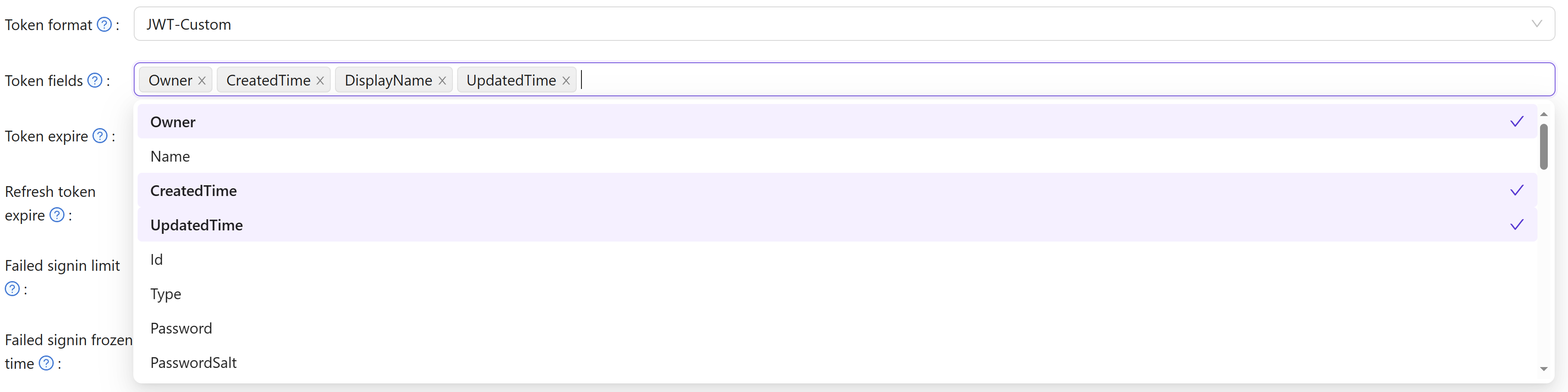
owner、name、id、displayName、avatar、email、email_verified和phone - JWT-自定义:包含您选择的自定义用户令牌字段(在令牌字段中选择属性)
- JWT标准:以符合OIDC的格式包含标准OIDC声明(电子邮件、电话、性别、地址)
在应用的 OIDC/OAuth 选项卡中设置 Token format(令牌格式)。空值表示 JWT。新创建的应用会使用其组织的 Default token format(默认令牌格式)以及来自组织 Advanced(高级)选项卡的 Default token fields(默认令牌字段)作为其 Token fields(令牌字段)。更改这些默认值不会影响现有应用。客户端通过动态客户端注册创建的应用也会获得相同的默认值。
**只有 JWT-Standard 会生成符合 OIDC 规范的 address 声明。**在 JWT、JWT-Empty 和 JWT-Custom 格式中,address 字段是原始的 []string 数组(用户的 Address 属性),不符合 OIDC 规范。如果你的应用把 address 声明当作对象解析,请使用 JWT-Standard 令牌格式。
群组格式
应用程序 OIDC/OAuth 选项卡上的 Token group format 决定了 groups 声明如何在 /api/userinfo 的响应以及携带该声明的令牌格式中对用户的群组进行命名:JWT 始终包含,JWT-Custom 仅在 Token fields 中选中 Groups 时包含。JWT-Empty 和 JWT-Standard 令牌不包含 groups 声明:
| Option | Value in groups |
|---|---|
| ID (org/group) | <organization>/<group>. This is the default |
| Path (org/parent/group) | 从顶级群组开始的完整路径,例如 <organization>/<parent-group>/<group> |
| Name (group) | <group> |
Path (org/parent/group) 取代了 conf/app.conf 中已不再存在的 useGroupPathInToken 选项。
用 Token fields 限制字段
应用上的 Token fields 设置(用于为 JWT-Custom 格式挑选自定义用户属性)同时也是 /userinfo 接口的白名单。
- Token fields 为空时不启用白名单:令牌载荷和
/userinfo响应都包含默认的全部字段。这是默认行为。 - Token fields 列出了一个或多个字段时,只返回这些字段。不在列表中的用户属性,在
JWT-Custom令牌载荷和/userinfo响应中都会被省略。
白名单按底层的用户属性名匹配。例如,要通过 /userinfo 返回显示名、邮箱和头像,把 Name、Email 和 Avatar 加到 Token fields。字段仍受申请的 OAuth scope 约束,例如只有授予了 email scope 才返回 Email,只有 address scope 才返回 Location(即 address 声明),只有 phone scope 才返回 Phone。无论白名单如何,sub 和 aud 声明总会返回。
配置 Token fields 会限制 /userinfo,而不只是令牌。如果你之前依赖 /userinfo 返回所有字段,在这里添加条目后,该响应就会开始被过滤。要保持完整响应,就让 Token fields 留空。
OIDC 地址声明
OIDC 规范 把 address 声明定义为包含以下字段的 JSON 对象:
| Field | Description |
|---|---|
格式化 | 完整邮寄地址,已格式化以便显示 |
街道地址 | 街道地址组成部分(可能包含门牌号、街道名称、邮政信箱信箱等) |
所在地 | 城市或所在地 |
地区 | 州、省、地级市或地区 |
邮政编码 | 邮编或邮政编码 |
国家 | 国家名称 |
Casdoor如何将用户数据映射到地址声明
Casdoor在两个独立的用户字段中存储地址信息:
位置(字符串):一个通用的位置字符串(例如,“纽约”). 请求addressscope 时,/api/userinfo接口返回的纯字符串address值就取自这个字段。地址(字符串数组):地址行字符串数组(例如,["123 Main St", "Anytown, NY 12345", "USA"]). JWT-Standard 令牌中符合 OIDC 规范的address声明以这个字段为来源。
JWT-标准地址声明
请求 address scope 并使用 JWT-Standard 格式时,Casdoor 会在令牌中返回如下对象:
{
  "address": {
    "street_address": "123 Main St\nAnytown, NY 12345\nUSA",
    "formatted": "",
    "locality": "",
    "region": "",
    "postal_code": "",
    "country": ""
  }
}
street_address 字段是用户 Address 数组中各项用换行符连接后的结果。其余的 OIDC 地址子字段(formatted、locality、region、postal_code、country)目前为空,因为 Casdoor 把整个地址以自由格式的多行文本存在 Address 数组中,而不是按组成部分分字段存储。
非标准格式(JWT、JWT-Empty、JWT-自定义)
在 JWT、JWT-Empty 和 JWT-Custom 令牌格式中,address 字段是用户对象原始的 Address 属性,即一个字符串组成的 JSON 数组,而不是 OIDC 地址对象:
{
  "address": ["123 Main St", "Anytown, NY 12345", "USA"]
}
按照 OIDC 规范期望 address 声明是 JSON 对象的 OIDC 客户端会解析失败。如果需要令牌中有符合规范的 address 声明,请切换到 JWT-Standard。
标准OIDC声明
所有JWT令牌格式均在有效负载中包含这些标准OpenID Connect声明:
sub:主体标识(唯一的用户 ID)email:用户的邮箱地址email_verified- 布尔值,指示电子邮件地址是否经过验证:用户通过 Casdoor 的代码或魔法链接确认了邮箱,或者创建该用户的 OAuth 提供商为其提供了验证担保name或preferred_username- 用户的显示名称picture或avatar- 用户头像URL
有了 email_verified 声明,把 Casdoor 当作身份提供商的外部应用可以直接从令牌判断邮箱是否已验证,无需再调 API。
当用户通过 OAuth 提供商注册时,Casdoor 会从该提供商获取电子邮件地址的验证状态。例如,Google 会在其 email_verified 声明中报告此状态,而自定义 OAuth 提供商可以映射 emailVerified 字段。GitHub、GitLab、Gitee、Facebook、LinkedIn、DingTalk、Lark 和 Twitter 等提供商会将它们返回的所有电子邮件地址视为已验证。
JWT 格式还包含用户的 lastSigninTime 和 lastSigninIp 字段。在密码授予类型的令牌中,这些字段描述的是上一次登录信息,因为 Casdoor 是在签发令牌之后才记录本次登录的。当前登录的时间对应于 iat 声明。
自定义令牌属性
使用JWT-自定义格式,定义自定义属性及其数据类型。每个属性都包含一个类型字段,用于控制值如何包含在JWT中:
- 数组:即使属性值仅包含一个元素,也始终以数组形式返回。这可确保与期望角色、组或权限等字段采用数组类型的OIDC客户端兼容。
- 字符串:属性值将作为单个字符串返回(如果存在多个值,则返回第一个元素)。
空属性会自动从标记中省略,以保持有效负载的简洁。在为角色、组或权限配置属性时,建议使用数组类型,以更好地符合OIDC规范,并与Rancher和Keycloak等系统兼容。